PASQUALE PALUMBO HOME PAGE

Seminari di Automatica allo IASI
10th ESMTB Euro Summer School
SICILY (Italy) 13 September - 26 September 2009)

Parameter Estimation in Physiological Models

The 2009 Summer School is part of a series of 4 events from 2007 to 2010: each event consists of a summer school and associated workshop on modeling of human physiological systems with medical applications. The events are sponsored by the European Union under the program Marie Curie Conferences and Training Course

POSITION     EDUCATION     TEACHING     RESEARCH     PUBLICATIONS     CURRICULUM


Versione in italiano              last changes: 29/04/09

Prediction is difficult, especially of the future.

Niels Bohr


BIOGRAPHICAL SKETCH

Pasquale Palumbo was born in Pescara, Italy, December 18, 1970
He is married and lives in Pescara.
Ph.D. in Electronic Engineering, February 10, 2000
CNR Researcher, since March 2005


POSITION      

Researcher at the Institute of System Analysis and Computer Science (IASI "Antonio Ruberti") of the CNR in Rome, Italy, since March 22, 2005, in the field of "System and Control Theory" (ING-INF/04).
Address: Viale Manzoni 30, 00185 Rome.
Ph.: ++39 06 7716436         Fax: ++39 06 7716461                    E-mail:
pasquale.palumbo@iasi.cnr.it

POSITIONS SERVED           

Research Associate at the Institute of System Analysis and Computer Science (IASI "Antonio Ruberti") of the CNR in Rome, Italy, (May 20, 2000 -- March 21,2005), in the field of "System and Control Theory" (ING-INF/04).


EDUCATION

  • Ph.D. in Electronic Engineering, Faculty of Engineering, University of L'Aquila, February 10, 2000. Supervisor: Prof. A. Germani. The thesis (in Italian) deals with the control of undamped flexible structure, by using a functional approach. Most important results concerns the implementation of a finite dimensional control law, whose performances converge to the ones of the infinite dimensional optimal control law, as the approximation index increases to infinity. Taking into account the stability properties of the proposed control law, they are robust with respect to the system physical parameters.
  • Qualification to the profession of Engineer, 120/120, University of L'Aquila, December 1995.
  • Laurea Degree in Electronic Engineering, 110/110 cum laude, University of L'Aquila, Engineering Faculty, July 20, 1995. The thesis (in Italian) deals with the optimal polynomial filtering for linear discrete-time non Gaussian systems. Supervisor: Prof. A. Germani.
  • "G. Galilei" High School Scientific Degree, 60/60, Pescara, July 1989.


TEACHING ACTIVITY
UNIVERSITY OF L'AQUILA, A.A. 2008/09


MESSAGE:
STUDENTS CAN CONTACT PROF. P. PALUMBO IN ROME AT:
06 7716436     (IASI - Viale Manzoni, 30)
06 30155389   (BioMatLab, c/o Policlinico Gemelli)


  • Contract Professor of "Systems Biology", specialistic laurea degree in Mathematics Engineering (lessons  in English)
  • Teaching Assistant in:
    •  "Teoria dei Sistemi", Prof. C. Manes, first level laurea degree in Computer Science and Control, Electronic, Telecommunication Engineering
    Download:     
    • "Teoria dei Sistemi", Prof. P. Pepe, first level laurea degree in Magement Engineering
    • "Identificazione dei Modelli e Analisi dei Dati", Prof. A. Germani, first level laurea degree in Telecommunication Engineering
    • "Sistemi di Regolazione e Controllo", Prof. P. Pepe, first level laurea degree in Electrical Engineering
    • "Complementi di Automatica", Prof. A. Germani, specialistic laurea degree in Computer Science and Control Engineering
  

  • At the University of L'Aquila, Pasquale Palumbo has been Contract Professor of:
    • "Teoria dei Sistemi II", first level laurea degree in Computer Science and Control Engineering, A.A. 2003/04 - 2006/07;
    • "Controlli Automatici II", first level laurea degree in Computer Science and Control Engineering, A.A. 2002/03;
    • "Calcolo delle Probabilità e Statistica", first level laurea degree in Civil Engineering, A.A. 2001/02;
    • "Calcolo delle Probabilità", laurea degree in Civil and Environmental Engineering, A.A. 2000/01
Didactic Publications (in Italian):

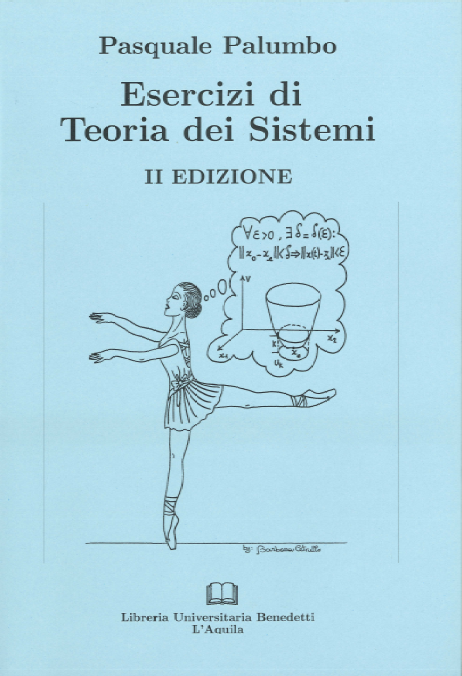
  • "ESERCIZI DI TEORIA DEI SISTEMI - PARTE I", Libreria Universitaria Benedetti, L'Aquila, September 2003, ISBN 88-87182-14-0
  • ESERCIZI DI TEORIA DEI SISTEMI - II EDIZIONE", Libreria Universitaria Benedetti, L'Aquila, Settembre 2008, ISBN 978-88-87182-31-6
  SYSTEM THEORY – Prof. C. Manes
Computer Science and Control Engineering
Electronic Engineering
Telecommunication Engineering

SYSTEM THEORY – Prof. P. Pepe
Management Engineering

                      
NEW EDITION:

More than 100 exercises all endowed with solutions above time-invariant finite-dimensional linear systems:
1) continuous and discrete time evolution: time and frequency domain approach (Laplace and Z transforms)
2) representation of transfer functions: Bode and polar
 diagrams
3) time-invariant linear systems stability; continuous-time systems (Routh criterion), discrete-time systems (Jury criterion), feedback systems (Nyquist criterion)
NEW PARAGRAPH on nonlinear systems stability
4) NEW CHAPTER on
controllability, observability and Kalman decomposition


Supervisor/Co-Supervisor of more than 70 theses in Computer Science and Control Egineering (in Italian):
                          First Level Laurea Degree (in Italian)                                              Five Years Laurea Degree (in Italian)                                              First Level Laurea Degree (in Italian)


  • Pasquale Palumbo can be found for explanations and theses assistance at the Automatic Control and Robotics Laboratory (LabAuRo), Faculty of Engineering, University of L'Aquila.


  • Ph.: ++39 0862 434453
  • Fax: ++39 0862 434403
  • Email: ppalumbo@ing.univaq.it


RESEARCH TOPICS
  • Control of flexible systems, a functional approach: flexible structures can be accurately described by continuum models, i.e. dynamic systems with infinite-dimensional state space. Therefore, any finite-dimensional model necessarily neglects the higher order vibration modes. On the other hand, a control law can be implemented only if it admits a finite-dimensional representation. Two main approaches can be followed to obtain finite-dimensional control laws for infinite-dimensional systems, such as flexible structures: according to the classical approach, a finite-dimensional control law is designed on the basis of a finite-dimensional approximation of the flexible structure (finite elements, Galerkin projections, or other approximation schemes); however, such a classical approach neglects the higher order modes of vibration of the structure, so that in many cases the unmodeled modes can be excited by the control law itself, so inducing undesired and unexpected vibrations in the structure, phenomenon known as spillover. Because of the intrinsic infinite-dimensional nature of the mechanical structure, any control law designed on the basis of a finite-dimensional model may produce this undesired effect. On the other hand, according to a modern approach, a finite-dimensional control law is designed on the basis of a distributed parameter model of the flexible structure. Such a modern approach allows to overcome the drawbacks of the classical one, in that it provides feedback control laws suitably designed exploiting the infinite-dimensional model, where all the modes of vibration of the system are considered. With this approach, the spillover effects are avoided by ensuring the closed loop stability for the original flexible structure. When the regulator is achieved without taking its physical realizability into account, the resulting feedback control law may well be defined as an operator acting on an infinite-dimensional state space. In these cases, a finite-dimensional approximation scheme is needed in order to implement the control law. In order to make effective such a methodology, for any approximation index, the corresponding regulator has to ensure the modal stability of the system, in order to overcome the spillover. The paper R[7] (taken from the Ph.D. dissertation) deals with the LQG control of an undamped Euler-Bernoulli cantilever beam with a tip mass at the free end. The optimal solution to such a problem is available in the literature, and is achieved in an infinite-dimensional setting; also an approximate implementable transfer function is provided. However it is not clear how far the proposed approximate compensator is from the optimal solution. The idea of the paper is to present a sequence of approximate, physically implementable regulators converging to the optimal LQG solution. It is proved that, for any given finite time horizon, the evolution of the system state driven by the approximate control input converges in L2-norm to the evolution of the system state driven by the optimal control law, as the order of the approximation scheme increases. An interesting feature is that the transfer function of the approximated compensator monotonically approaches the shape of the transfer function of the optimal compensator, as it can be appreciated in the magnitude/phase Bode representation. Preliminary results have been presented in C[2]. In R[7] it is proved also that, for each order of the approximation, the closed loop system is strongly stable, and, moreover, the proposed compensator guarantees modal stability of the closed loop system also in the presence of stiffness/inertia uncertainties. Such performances are indeed achieved by means of a Galerkin approximation scheme, based on the complete set of the generalized eigenfunctions of the structure instead of the usual splines. In C[3], an implementable Luenberger-like observer has been proposed for a similar undamped flexible structure, whose measurements are acquired with a not negligible delay.
  • Filtering of non Gaussian singular linear systems: it is well known that the optimal solution to the minimum variance filtering problem is given by the expectation value of the state conditioned by all the measurements up to the current time, that is the projection onto the linear space of all the Borel functions of the measurements. In the linear Gaussian case the optimal filter is given by the Kalman filter, which is a linear transformation of the measurements. Unfortunately, in the non Gaussian case, there is not a simple characterization of the conditional expectation, so that it is worthwhile to consider suboptimal estimates which have a simpler mathematical structure. The simplest suboptimal estimate is the optimal affine one. It consists in projecting the state onto the subspace of all the linear transformations of the output. For linear systems the optimal affine estimate is still achieved by the Kalman filter. Suboptimal estimates comprised between the optimal linear and the conditional expectation can be considered by projecting onto subspaces of polynomial transformations of the measurements. A quadratic filter has been implemented in C[1], for a digital linear system, whose measurements are affected by quantization noise. The optimal polynomial approach has been proposed for the filtering of linear singular systems (also known as descriptor systems). Pubblications in this field use the measurements in order to overcome the lack of knowledge coming from the singular model. According to non restrictive hypotheses, a regular system is associated to the singular model, whose state, filtered by using a polynomial estimate, univocally identify the descriptor vector. In R[2], the polynomial filter has been proposed in the discrete-time framework (a preliminar version has been presented in C[12]). It has been proved that the linear version C[4], gives back the maximum likelihood estimate, in the Gaussian case. In C[5] a Kalman-Bucy-like filter is achieved for a singular stochastic differential system, in the Ito formulation.
  • Filtering and identification of variable structure systems: the research activity investigates the problem of state etimation and system identification for the general class of stochastic uncertain systems, in the discrete time framework. A very interesting case is the one of switching systems, that is systems whose matrices switch according to an unknown parameter. Taking into account the case of a Markovian switching parameter, a suitable state space realization has been proposed. It has been proved that the minimum variance linear approach C[7] (or the others available in literature) is not enough to simultaneously estimate both the state and the unknown parameter, unless a known input suitably excites the system. On the contrary, a polynomial approach C[10] is able also to identify the system even in complete absence of a known input. Such a polynomial approach has been applied to a digital telecommunication system, providing in real-time both system identification and channel estimation. In R[4], the case of absence of any stochastic or deterministic characterization of the switching parameter has been investigated. Such a loss of knowledge has been modeled by using an extended singular system, driven by bounded covariance extended noises, whose second order moments are not completely known. Then the minimax criterion is adopted (a preliminary version of the paper has been presented in C[6]). Simulations reported in R[4] show the effectiveness of the proposed approach, compared with other robust filters, such has the ones based on LMIs, or on the maximum entropy criterion. Moreover, in R[4], the asymptotic properties of the filter have been investigated. In C[11, 13] the uncertainties of the model deal with one or more unknown constant (or even slowly time-varying) parameters, taking values in a suitably defined discrete C[11] or continuous C[13] range. An extended state is defined, containing among its components the uncertain parameters and, then, is filtered by using the polynomial approach. The same problem of simultaneous parameter identification and filtering has been investigated in C[18], for a generic class of interval nonlinear systems. Analogously to the linear case, the approach is based on a suitably defined extended state, including the unknown parameters among its components: the extended state estimate is then achieved by means of the Polynomial EKF (PEKF), R[3].
  • Filtering of stochastic nonlinear systems: taking into account the field of continuous time systems, the state estimate problem has been investigated in R[1] for a bilinear stochastic differential system, driven by unknown inputs. According to the Ito formulation, the measurements overcome the loss of knowledge concerning the unknown input, so that the optimal linear state estimate is achieved. In the discrete time framework, the case of stochastic linear systems driven by unknown nonlinearities has been investigated in C[8]: an extended singular system is considered, in order to model the uncertainties, and the state is filtered by using the minimum variance criterion. In R[3] the polynomial version of the Extended Kalman Filter (EKF), so widely used in many engineering frameworks, has been developed. According to the linear approximation of the system, the EKF performs well if the initial estimation error and the disturbing noises are small enough. On the other hand, the Polynomial-EKF (PEKF) is based on the Carleman stochastic bilinearization of the system, whose extended state is filtered by means of the minimum variance estimate; a preliminary version of R[3] has been presented in C[9]. A double index version of the PEKF has been proposed in C[15], where the first index is related to the degree of approximation of the nonlinear system, while the other is related to the order of the polynomial estimate adopted. The Carleman approximation has been also used in R[10], in order to estimate the state of a nonlinear stochastic differential system: the algorithm consists of the optimal linear filter applied to the bilinear differential system approximating the original model (a preliminary version had been presented in C[19]).  In C[23] a polynomial filtering approach has been used in a telecommunication framework: a recursive filtering algorithm is proposed for log-Rice signals generated by the envelope of noisy narrow band Gaussian signals through noisy logarithmic amplifiers. A class of filters is considered, and within this class the filter providing the optimal estimate is computed. A polynomial filtering approach has been used also in a robotic framework C[24], where a new analytical algorithm performs the localization of a mobile robot using odometry and laser readings. The algorithm provides the optimal affine filter in a class of suitably defined estimators. The comparison with the standard Extended Kalman Filter shows the efficiency of the proposed filter also in critical situations where the system nonlinearities cause a bad behavior of the EKF.
  • State observers for deterministic nonlinear systems: in C[14] a state observer for continuous-time deterministic systems characterized by linear input-state dynamics and polynomial state-output function. The observer design is based on the embedding of the original dynamics into a higher order system, with time-varying linear state dynamics and linear state-output maps. The interest in this observer is in its capability of state reconstruction also in cases in which the original system is not drift-observable (observable from zero-inputs) nor uniformly observable (observable from any input). In C[22] the same methodology has been applied for systems characterized by output functions that are ratios of polynomials of the state. The case of linear and bilinear input-state dynamics is considered. Both C[14] and C[22] provide conditions for exponential error decay. From an applicative point of view, in C[16] an asymptotic observer for nonlinear systems (previously published by part of the authors) has been implemented in order to estimate the insulin flow from pure glucose measurements, taking into account a dynamical model of the glucose/insulin homeostasis.
  • Control of stochastic systems: in C[25] the optimal control problem has been investigated for a linear stochastic system affected by disturbances generated by a nonlinear stochastic exosystem. The approach followed is based on the Carleman approximation of a stochastic nonlinear system [R3], and provides a real-time algorithm to design an implementable control law.
  • Modeling and control of the glucose/insulin homeostasis (research activity developed at the BioMatLab of IASI, located at the Policlinico Gemelli Hospital): the homeostasis of glucose, involving the secretion of its controlling hormone insulin by pancreas is the object of several mathematical models over the past thirty years. One of the goals of this modeling effort is the measurement of the degree to which a given subject is able to accomodate a load of glucose (for instance administred as an intra-venous bolus, the well knwon Intra-Venous Glucose Tolerance Test, IVGTT). The fact that several attempts at modeling the glucose-insulin system have been made in the past points to the actual difficulty in constructing a model which is at the same time mathematically coherent, statistically robust and physiologically meaningful. In other words, the model should exhibit satisfactory properties of the solutions, its parameters should be statistically estimable with sufficient precision from data sets obtained from standard experimental procedures, and it should conform to established physiological concepts. So far, indeed, no single model exhibiting simultaneously all of these features has been proposed. In R[8] a family of delay-differential models of the glucose-insulin system is presented, whose members represent adequately the Intra-Venous Glucose Tolerance Test and allied experimental procedures of diabetological interest. Different models of the family have been identified from IVGTT data R[9], providing excellent results in terms of parameter estimation. These models, then, appear statistically and physiologically promising. In R[8] the mathematical analysis has been performed. All the models in the family admit positive bounded unique solutions for any positive initial condition and are persistent. The models agree with the physics underlying the experiments, and they all present a unique positive equilibrium point. Local stability is investigated in a pair of interesting member models: one, a discrete-delays differential system (a preliminar version of the model is presented in C[20]); the other, a distributed-delay system reducing to an ordinary differential system evolving on a suitably defined extended state space. In both cases conditions are given on the physical parameters in order to ensure the local asymptotic stability of the equilibrium point. These conditions are always satisfied, given the actual parameter estimates obtained experimentally. A study of the global stability properties is also performed. The modeling of insulin absorption from a subcutaneous infusion has been investigated in R[5], where a pair of time-varying periodic models have been proposed, both taking into account the fact that different absorption rates are associated with different times of a 24 hour period (a preliminary version of the paper has been presented in C[17]). In B[1] and C[21] the problem of tracking a desired level of plasma glycemia has considered, by means of continuous intravenous injection. Based on a single-distributed delay model which allows to properly take into account also a pancreatic insulin production , the closed loop control law is performed according to the feedback linearization theory: a state feedback is designed in order to exactly linearize the model w.r.t. a suitably defined change of coordinates. Then, the tracking of the deired level is achieved. In C[21] such a task is obtained by means of the minimization of a suitably defined performance index, which takes into account a desired glycemic profile. Of course, the parameter identification and the aim of a closed loop control are strictly related to the capability and quality of both glucose and insulin concentration measurements in plasma. At the present time, the former measurement is accurately achieved with low cost devices, while the latter is expensive and not immediate. In C[16] an asymptotic observer for nonlinear systems has been implemented in order to estimate the insulin flow from pure glucose measurements, taking into account a recent dynamical model of the glucose/insulin kinetics.
  • Higher order methods for the solution of nonlinear equations: it is well known that, looking for the solution of nonlinear equations, the Newton's method has local quadratic convergence, according to a set of non restrictive convergence conditions. In R[6] a new iterative method for the scalar case is proposed, based on a suitable polynomial model derived from the Taylor series expansion. Providing the same Newton's convergence conditions, it achieves a convergence rate increasing with the approximation degree. Moreover, an easy implementable scheme is obtained, according to a specific matrix factorization, achieved in a closed form (i.e. no further numerical computation), by using the Jordan decomposition.

PUBLICATIONS ON INTERNATIONAL JOURNALS

R[1] A. Germani, C. Manes, P. Palumbo, ''Optimal linear filtering for bilinear stochastic differential systems with unknown inputs'',  IEEE Trans. on Automatic Control, Vol. 47, No. 10, pp. 1726-1730, 2002
R[2] A. Germani, C. Manes, P. Palumbo, ''Polynomial filtering for stochastic non Gaussian descriptor systems'', IEEE Trans. on Circuits and Systems - I: Regular Papers, Vol. 51, No. 8, pp. 1561-1576, 2004
R[3] A. Germani, C. Manes, P. Palumbo, ''Polynomial Extended Kalman Filter'', IEEE Trans. on Automatic Control, Vol. 50, No. 12, pp. 2059-2064, 2005
R[4] A. Germani, C. Manes, P. Palumbo, ''Filtering for bimodal systems: the case of unknown switching systems'', IEEE Trans. on Circuits and Systems - I: Regular Papers, Vol. 53, No. 6, pp. 1266-1277, 2006
R[5] P. Palumbo, W.H. Ong-Clausen, S. Panunzi, A. De Gaetano, ''Linear periodic models of subcutaneous insulin absorption: mathematical analysis'', HERMIS Journal, Special Issue on Differential and Integral Equations in Physics Epidemiology and Medicine: Application and Numerics, Vol. 7, pp. 60-79, 2006
R[6] A. Germani, C. Manes, P. Palumbo, M. Sciandrone, ''A higher order method for the solution of nonlinear scalar equations'', Journal of Optimization Theory and Applications, Vol. 131, No. 3, pp. 347-364, 2006
R[7] A. Germani, C. Manes, P. Palumbo, P. Pepe, ''A robust approximation scheme for the LQG control of an undamped flexible beam with a tip mass'', European Journal of Control, Vol.12, No.6, pp. 635-651, 2006
R[8] P. Palumbo, S. Panunzi, A. De Gaetano, ''Qualitative behavior of a family of delay-differential models of the glucose-insulin system'', Discrete and Continuous Dynamical Systems - Series B, Vol. 7, No. 2, pp. 399-424, 2007
R[9] S. Panunzi, P. Palumbo, A. De Gaetano, ''A discrete single-delay model for the Intra Venous Glucose Tolerance Test'', Theoretical Biology and Medical Modelling, Vol. 4, No. 35, 16 pagine, 2007
R[10] A. Germani, C. Manes, P. Palumbo, ''Filtering of stochastic nonlinear differential systems via a Carleman approximation approach'', IEEE Trans. on Automatic Control, Vol. 52, No. 11, pp. 2166-2172, 2007
R[11] P. Palumbo, U. Picchini, B. Beck, J. Van Gelder, N. Delbar, A. De Gaetano, ''A general approach to the apparent permeability index'', Journal of Pharmacokinetics and Pharmacodynamics, Vol.35, pp.235-248, 2008
R[12] D.V. Giang, Y. Lenbury, A. De Gaetano, P. Palumbo, ''Delay model of glucose-insulin systems: global stability and oscillated solutions conditional on delays'', Journal of Mathematical Analysis and Applications, Vol.343, Issue 2, pp.996-1006, 2008
R[13] A. De Gaetano, T. Hardy, B. Beck, E. Abu-Raddad, P. Palumbo, J. Bue-Valleskey, N. Porksen, "Mathematical models of diabetes progression'', American Journal of Physiol. Endocrinol. Metab., Vol.295, pp.E1462-E1479, 2008
R[14] A. Germani, C. Manes, P. Palumbo, ''State estimation of stochastic systems with switching measurements: a polynomial approach'', in press on International Journal of Robust and Nonlinear Control, 2009


PUBLICATIONS ON MULTIAUTHOR BOOKS


B[1] P. Palumbo, A. De Gaetano, ''State-feedback control of the glucose-insulin system", MATH EVERYWHERE. Deterministic and Stochastic Modelling in Biomedicine, Economics and Industry. G. Aletti, M. Burger, A. Micheletti, D. Morale Editors, Springer, Heidelberg, pp. 241-252, 2006


PUBLICATIONS ON THE PROCEEDINGS OF INTERNATIONAL CONFERENCES

C[1] M. Dalla Mora, C. Manes, P. Palumbo, ''Optimal quadratic filtering of quantization noise in non-Gaussian systems'', UKACC International Conference on Control 96, pp. 1091-1096, Exeter, UK, 1996
C[2] C. Manes, P. Palumbo, P. Pepe, ''An approximation scheme for the LQG control of flexible structures'', 5th European Control Conference (ECC99), Karlsruhe, Germany, 1999
C[3] P. Palumbo, ''A realizable observer for a flexible system with delayed outputs'', 2nd IFAC Workshop on Linear Time Delay Systems (LTDS2000), pp. 64-69, Ancona, Italy, 2000
C[4] A. Germani, C. Manes, P. Palumbo, ''Optimal linear filtering for stochastic non-Gaussian descriptor systems'', 40th Conference on Decision and Control (CDC01), pp. 2514-2519, Orlando, Florida, 2001
C[5] A. Germani, C. Manes, P. Palumbo, ''Kalman Bucy filtering for linear stochastic differential systems with unknown inputs'', 15th IFAC World Congress on Automatic Control (IFAC2002), Barcelona, Spain, 2002
C[6] A. Germani, C. Manes, P. Palumbo, ''Filtering switching systems via a singular minimax approach'', 41st Conference on Decision and Control (CDC02), pp. 2600-2605, Las Vegas, Nevada, 2002
C[7] A. Germani, C. Manes, P. Palumbo, ''State estimation for a class of stochastic variable structure systems'', 41st Conference on Decision and Control (CDC02), pp. 3027-3032, Las Vegas, Nevada, 2002
C[8] A. Germani, C. Manes, P. Palumbo, ''A minimum variance filter for discrete time linear systems perturbed by unknown nonlinearities'', IEEE International Symposium on Circuits and Systems (ISCAS2003),  Bangkok, Thailand, 2003
C[9] A. Germani, C. Manes, P. Palumbo, ''Polynomial extended Kalman filtering for discrete-time nonlinear stochastic systems'', 42nd Conference on Decision and Control (CDC03), pp. 886-891, Maui, Hawaii, 2003
C[10] A. Germani, C. Manes, P. Palumbo, ''Polynomial filtering for stochastic systems with Markovian switching coefficients'', 42nd Conference on Decision and Control (CDC03), pp. 1392-1397, Maui, Hawaii, 2003
C[11] D. Di Martino, A. Germani, C. Manes, P. Palumbo, ''Polynomial approach for filtering and identification of a class of uncertain systems'', 2nd IFAC Symposium on System, Structure and Control (SSSC04), pp. 579-584, Oaxaca, Mexico, 2004
C[12] A. Germani, C. Manes, P. Palumbo, ''Polynomial filtering for stochastic non-Gaussian descriptor systems'', 43rd Conference on Decision and Control (CDC04), pp. 2088-2093, Paradise Island, The Bahamas, 2004
C[13] D. Di Martino, A. Germani, C. Manes, P. Palumbo, ''Quadratic filtering for simultaneous state and parameter estimation of uncertain systems'', 43rd Conference on Decision and Control (CDC04), pp. 3569-3574, Paradise Island, The Bahamas, 2004
C[14] D. Di Martino, A. Germani, C. Manes, P. Palumbo, "State observation for linear systems with polynomial w.r.t. state output", 43rd Conference on Decision and Control (CDC04), pp. 3886-3891, Paradise Island, The Bahamas, 2004
C[15] A. Germani, C. Manes, P. Palumbo, ''A family of polynomial filters for discrete-time nonlinear stochastic systems'', 16th IFAC World Congress on Automatic Control (IFAC2005), Prague, Czech Republic, 2005
C[16] A. De Gaetano, D. Di Martino, A. Germani, C. Manes, P. Palumbo, ''Distributed-delays models of the glucose-insulin homeostasis and asymptotic state observation'', 16th IFAC World Congress on Automatic Control (IFAC2005), Prague, Czech Republic, 2005
C[17] P. Palumbo, W.H. Ong-Clausen, S. Panunzi, A. De Gaetano, "Analysis of an impulsive model of subcutaneously delivered insulin kinetics'', 7th Hellenic European Conference on Computer Mathematics and its Applications (HERCMA2005), Athens, Greek, 2005
C[18] A. Germani, C. Manes, P. Palumbo, ''Polynomial filtering and indentification of discrete-time nonlinear uncertain stochastic systems'', 44th Conference on Decision and Control & European Control Conference (CDC-ECC05), pp. 1917-1922, Seville, Spain, 2005
C[19] A. Germani, C. Manes, P. Palumbo, ''Filtering of differential nonlinear systems via a Carleman approximation approach'', 44th Conference on Decision and Control & European Control Conference (CDC-ECC05), pp. 5917-5922, Seville, Spain, 2005
C[20] P. Palumbo, S. Panunzi, A. De Gaetano, ''Stability analysis of a discrete-delay model of the glucose-insulin system'', 6th IFAC Workshop on Time Delay Systems (TDS06), L'Aquila, Italy, 2006
C[21] P. Palumbo, A. De Gaetano, ''A closed loop optimal control of the plasma glycemia'', 45th IEEE Conference on Decision and Control (CDC06), pp. 679-684, San Diego, California, 2006
C[22] D. Di Martino, A. Germani, C. Manes, P. Palumbo, ''Design of observers for systems with rational output function'', 45th IEEE Conference on Decision and Control (CDC06), pp. 1641-1646, San Diego, California, 2006
C[23] A. Germani, F. Graziosi, C. Manes, G. Ocera, P. Palumbo, ''Recursive filtering for log-Rice signals'', 45th IEEE Conference on Decision and Control (CDC06), pp. 3150-3155, San Diego, California, 2006
C[24] C. Manes, A. Martinelli, F. Martinelli, P. Palumbo, ''Mobile robot localization based on a polynomial approach'', International Conference on Robotics and Automation (ICRA07), Rome, Italy, pp. 3539-3544, 2007
C[25] G. Mavelli, P. Palumbo, ''A Carleman approximation scheme for a stochastic optimal nonlinear control problem'', 9th European Control Conference (ECC07), Kos, Greece, pp. 3672-3678, 2007
C[26] A. Germani, C. Manes, P. Palumbo, ''State space representation of a class of MIMO systems via positive systems'', 46th Conference on Decision and Control (CDC07), New Orleans, Louisiana, pp. 476-481, 2007
C[27] A. Germani, C. Manes, P. Palumbo, ''Simultaneous system identification and channel estimation: a hybrid system approach'', 46th Conference on Decision and Control (CDC07), New Orleans, Louisiana, pp. 1764-1769, 2007
C[28] G. Mavelli, P. Palumbo, ''A Carleman approximation scheme for a stochastic optimal control problem in the continuous-time framework'', accepted for presentation at 17th IFAC World Congress on Automatic Control (IFAC2008), Seoul, South Korea, July 2008
C[29] F. Carravetta, G. Felici, P. Palumbo, ''Regulation of a manned sea-surface vehicle via stochastic optimal control'', accepted for presentation at 17th IFAC World Congress on Automatic Control (IFAC2008), Seoul, South Korea, July 2008
C[30] P. Palumbo, P. Pierdomenico, S. Panunzi, A. De Gaetano, ''Robust closed-loop control of plasma glycemia: a discrete-delay model approach'', 47th Conference on Decision and Control (CDC08), Cancun, Messico, pp. 3330-3335, 2008


TECHNICAL RESEARCH REPORTS

Rc[1]
C. Manes, P. Palumbo, P. Pepe, ''Analysis of an approximation scheme for the LQG control of flexible structures'', Department of Electrical Engineering, Research Report, No. 98-27, L'Aquila, 1998
Rc[2] A. Germani, C. Manes, P. Palumbo, ''Polynomial filtering for stochastic non-Gaussian descriptor systems'', IASI-CNR Research Report, No. 526, Rome, 2000
Rc[3] A. Germani, C. Manes, P. Palumbo, ''Optimal linear filtering for bilinear stochastic differential systems with unknown inputs'', IASI-CNR Research Report, No. 541, Rome, 2000
Rc[4] A. Germani, C. Manes, P. Palumbo, ''Kalman Bucy filtering for singular stochastic differential systems'', IASI-CNR Research Report, No. 545, Rome, 2001
Rc[5] A. Germani, C. Manes, P. Palumbo, ''State estimation for a class of stochastic variable structure systems'', IASI-CNR Research Report, No. 548, Rome, 2001
Rc[6] A. Germani, C. Manes, P. Palumbo, ''Filtering of switching systems via a singular minimax approach'', IASI-CNR Research Report, No. 552, Rome, 2001
Rc[7] A. Germani, C. Manes, P. Palumbo, ''Polynomial filtering for stochastic systems with Markovian switching coefficients'', IASI-CNR Research Report, No. 570, Rome, 2002
Rc[8] A. Germani, C. Manes, P. Palumbo, ''Polynomial extended Kalman filtering for discrete-time nonlinear stochastic systems'', IASI-CNR Research Report, No. 572, Rome, 2002
Rc[9] A. Germani, C. Manes, P. Palumbo, ''A minimum variance filter for discrete-time linear systems perturbed by unknown nonlinearities'', IASI-CNR Research Report, No. 575, Rome, 2002
Rc[10] A. Germani, C. Manes, P. Palumbo, M. Sciandrone, ''A Newton-like higher order method for the solution of nonlinear equations'', IASI-CNR Research Report, No. 585, Rome, 2003
Rc[11] D. Di Martino, A. Germani, C. Manes, P. Palumbo, ''Quadratic filtering for simultaneous state and parameter estimation of uncertain systems'', IASI-CNR Research Report, No. 589, Rome, 2003
Rc[12] D. Di Martino, A. Germani, C. Manes, P. Palumbo, ''State observation for linear systems with linear state dynamics and polynomial output'', IASI-CNR Research Report, No. 595, Rome, 2003
Rc[13] D. Di Martino, A. Germani, C. Manes, P. Palumbo, ''A polynomial approach for simultaneous channel estimation and data detection'', IASI-CNR Research Report, No. 599, Rome, 2003
Rc[14] D. Di Martino, A. Germani, C. Manes, P. Palumbo, ''Polynomial approach for filtering and identification of a class of uncertain systems'', IASI-CNR Research Report, No. 603, Rome, 2003
Rc[15] A. Germani, C. Manes, P. Palumbo, '' A family of polynomial filters for discrete-time nonlinear stochastic systems '', IASI-CNR Research Report, No. 610, Rome, 2004
Rc[16] A. De Gaetano, D. Di Martino, A. Germani, C. Manes, P. Palumbo, ''Distributed-delay models of the glucose-insulin homeostasis and asymptotic state observation'', IASI-CNR Research Report, No. 618, Rome, 2004
Rc[17] P. Palumbo, S. Panunzi, A. De Gaetano, ''Qualitative properties of solutions for two delay-differential models of the glucose-insulin system'', IASI-CNR Research Report, No. 620, Rome, 2004
Rc[18] S. Panunzi, P. Palumbo, A. De Gaetano, ''Modeling IVGTT data with delay differential equations'', IASI-CNR Research Report, No. 625, Rome, 2004
Rc[19] C. Manes, A. Martinelli, F. Martinelli, P. Palumbo, ''Mobile robot localization based on a polynomial approach'', IASI-CNR Research Report, No.635, Rome, 2006
Rc[20] G. Mavelli, P. Palumbo, ''A Carleman approximation scheme for a stochastic optimal control problem in the continuous-time framework'', IASI-CNR Research Report, No.644, Roma, 2006
Rc[21] P. Palumbo, W.H. Ong-Clausen, S. Panunzi, A. De Gaetano, "Analysis of an impulsive model of subcutaneously delivered insulin kinetics'', IASI-CNR Research Report, No.647, Roma, 2006
Rc[22] A. Germani, F. Graziosi, C. Manes, G. Ocera, P. Palumbo, ''Recursive filtering for log-Rice signals'', IASI-CNR Research Report, No.649, Roma, 2006
Rc[23] P. Palumbo, A. De Gaetano, ''A closed loop optimal control of the plasma glycemia'', IASI-CNR Research Report, No.652, Roma, 2006
Rc[24] A. Germani, C. Manes, P. Palumbo, ''Polynomial filtering and indentification of discrete-time nonlinear uncertain stochastic systems'', IASI-CNR Research Report, No.655, Roma, 2006

The order of the authors is alphabetical in all the publications, except for R[5, 8, 9, 11, 12, 13], B[1], C[17, 20, 21, 30], Rc[17, 18, 21, 23]


NATIONAL AND INTERNATIONAL CONFERENCES ATTENDED
  • 1998, Tampa Bay, Florida: 37th Conference on Decision and Control (CDC98)
  • 1999, Karlsruhe, Germany: 5th European Control Conference (ECC99), speaker
  • 2000, Ancona, Italy: 2nd IFAC Workshop on Linear Time Delay Systems (LTDS2000), speaker
  • 2001, Lecce, Italy: Convegno nazionale di coordinamento (CIRA01), speaker
  • 2001, Orlando, Florida: 40th Conference on Decision and Control (CDC01), speaker
  • 2002, Barcelona, Spain: 15th IFAC World Congress on Automatic Control (IFAC2002), speaker
  • 2002, Las Vegas, Nevada: 41st Conference on Decision and Control (CDC02), speaker
  • 2003, Modena, Italy: Convegno nazionale di coordinamento (CIRA03), speaker
  • 2003, Maui, Hawaii: 42nd Conference on Decision and Control (CDC03), speaker
  • 2004, Villasimius (CA), Italy Convegno nazionale di coordinamento (CIRA04), speaker
  • 2004, Oaxaca, Mexico: 2nd IFAC Symposium on Systems, Structure and Control (SSSC04), speaker
  • 2004, Paradise Island, The Bahamas: 43th Conference on Decision and Control (CDC04), speaker
  • 2005, Prague, Czech Republic: 16th IFAC World Congress on Automatic Control (IFAC2005)
  • 2005, Milan, Italy: Math Everywhere, a Workshop to celebrate Vincenzo Capasso's 60th birthday (VK60), speaker
  • 2005, Tropea (VV), Italy: Convegno nazionale di coordinamento (CIRA05), speaker
  • 2005, Athens, Greece: 7th Hellenic Europ. Conf. on Computer Mathematics and its Applications (HERCMA2005), speaker
  • 2005, Seville, Spain: 44th Conference on Decision and Control & European Control Conference (CDC-ECC05), speaker
  • 2006, L'Aquila, Italy: 6h IFAC Workshop on Time Delay Systems (TDS2006), speaker
  • 2006, Milan, Italy: Convegno nazionale di coordinamento (CIRA06)
  • 2006, Milan, Italy2° Convegno Internazionale sui Problemi dell'Automatismo
  • 2006, San Diego, California: 45th Conference on Decision and Control (CDC06), speaker
  • 2007, Rome, Italy: International Conference on Robotics and Automation (ICRA07), speaker
  • 2007, Kos, Greece: 9th European Control Conference (ECC07), speaker
  • 2007, Genoa, Italy: Convegno nazionale di coordinamento (SIDRA07), speaker Occhi aperti!
  • 2008, New Orleans, Louisiana: 46th Conference on Decision and Control (CDC07), interactive presentation
  • 2008, L'Aquila, Italy: "Recenti sviluppi della Ricerca Matematica per le Scienze della Vita in Italia", Workshop CIMAB, speaker
  • 2008, Edimburgo, Scozia: European Conference on Mathematical and Theoretical Biology (ECMTB08), speaker
  • 2008, Seoul, Corea del Sud: 17th IFAC World Congress on Automatic Control (IFAC2008), speaker


Art. 11 della Costituzione Italiana: "L'Italia ripudia la guerra come strumento di soluzione delle controversie internazionali"